# Exchange 365
Connect your Exchange 365 source to Workplace AI to make the most of the data.
## **Initial Configuration Steps**
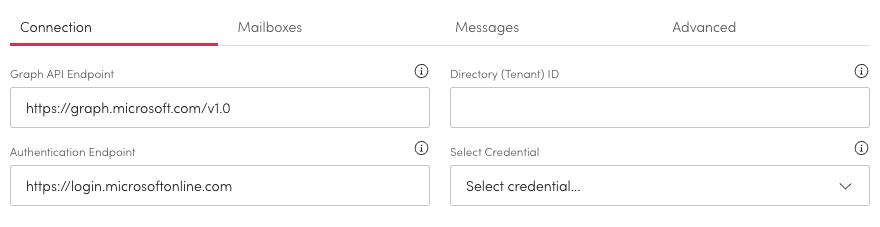
1. **Graph API Endpoint:** Change the Graph API Endpoint if different to the Microsoft default.
2. **Directory (Tenant) ID:** Enter the Directory or Tenant ID from azure.
* This can be found on the Azure Enterprise Application configuration pages.
3. **Authentication Endpoint:** Change your Authentication Endpoint if different to the Microsoft default.
4. **Select Credentials** Choose a credential and secret for Exchange 365 from the dropdown.
* You can find your credentials in the Azure Enterprise Application configuration pages.
* *For support setting up credentials use* [*our guide on managing credentials.*](https://docs.aiimi.com/aiimi-insight-engine/control-hub/security/credentials)
***
## Mailboxes
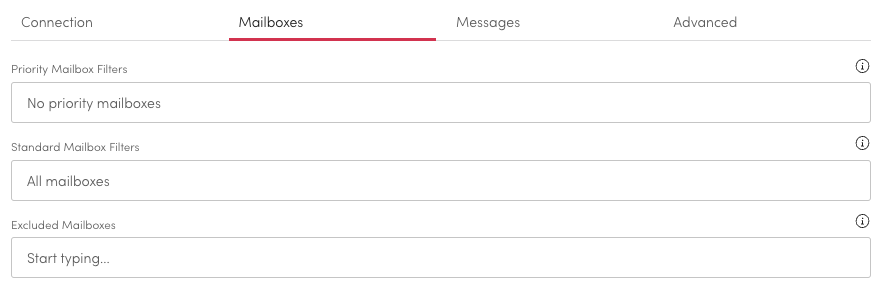
1. **Priority Mailbox Filters:** Enter an OData filter to pick the mailboxes processed first.
* If left blank no mailboxes will be prioritised.
* Any changes will only be applied to new crawls.
* Find OData filters in Microsoft Graph API documentation.
2. **Standard Mailbox Filters:** Enter an OData filter to pick the part of mailbox that is processed.
* If left blank all mailboxes will be processed.
* Any changes will only be applied to new crawls.
* Find OData filters in Microsoft Graph API documentation.
***
## Messages
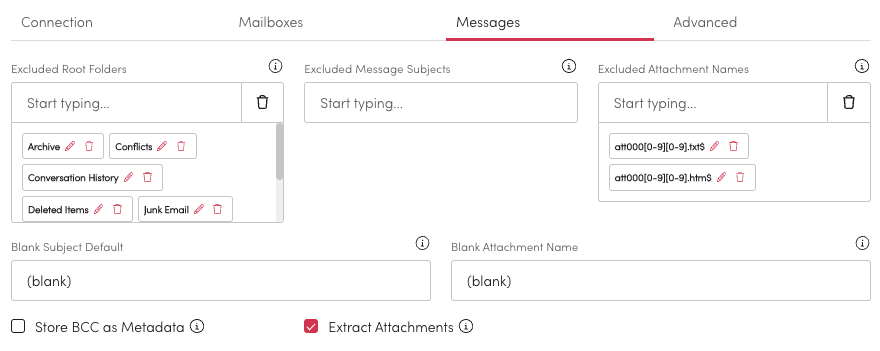
1. **Excluded Root Folders:** Enter the folders that should not be processed.
* Select the Edit (pencil) to edit any items in the list.
* Select the Delete (trash can) to remove items in the list.
2. **Exclude Message Subjects:** Enter any subjects that mean a message is excluded.
* Use a Regular Expression to exclude the subjects.
* If left blank all subjects will be processed.
3. **Excluded Attachment Names:** As a regular expression enter any attachment names that should be excluded.
* Use a Regular Expression to exclude the subjects.
* If left blank all attachments will be processed.
4. **Blank Subject Default:** Enter a subject to be used in place of any messages with a blank subject.
5. **Blank Attachment Name:** Enter an attachment name to be used if an attachment has no name.
6. **Store BCC as Metadata:** Check this to extract and store all BCC addresses. This applies to sent and received emails.
7. **Extract Attachments:** Check this to extract and store all attachments as separate files.
***
## **Advanced**
### Parallelism
Decide how many different task's are run at once.
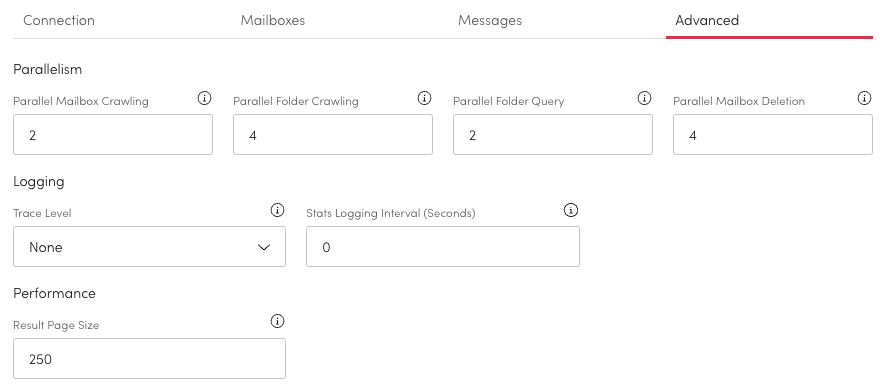
**Parallel Mailbox Crawling:** Enter the maximum number of mailboxes that should be crawled at once.
**Parallel Folder Crawling:** Enter the maximum number of folders, from one mailbox, that should be crawled at once.
**Parallel Folder Query:** Enter the number of Elastic queries, from one mailbox, that should be crawled at once. This can impact the Elastic performance.
**Parallel Mailbox Deletion:** Enter the number of folders that can be deleted at once. This can impact the Elastic performance.
### Logging
Select the Trace Level of the connection.
* None - Do not log graph calls
* Calls - Log URLs and status codes
* All - Log URLs, status codes, request forms and JSON responses
Change the Stats Logging Interval (Seconds) to determine how often anything is logged.
* This includes logging the total number of calls, call rates, HTTP errors and 429 errors.
* You can disable stats logging by setting this to 0.
### Performance
When scanning a source you can choose the number of results that will be retrieved in a request. To change the number of results change it on Result Page Size.
Some endpoints will ignore this and revert to defaults.
Search 'odata.maxpagesize' in the Microsoft Graph API documentation.